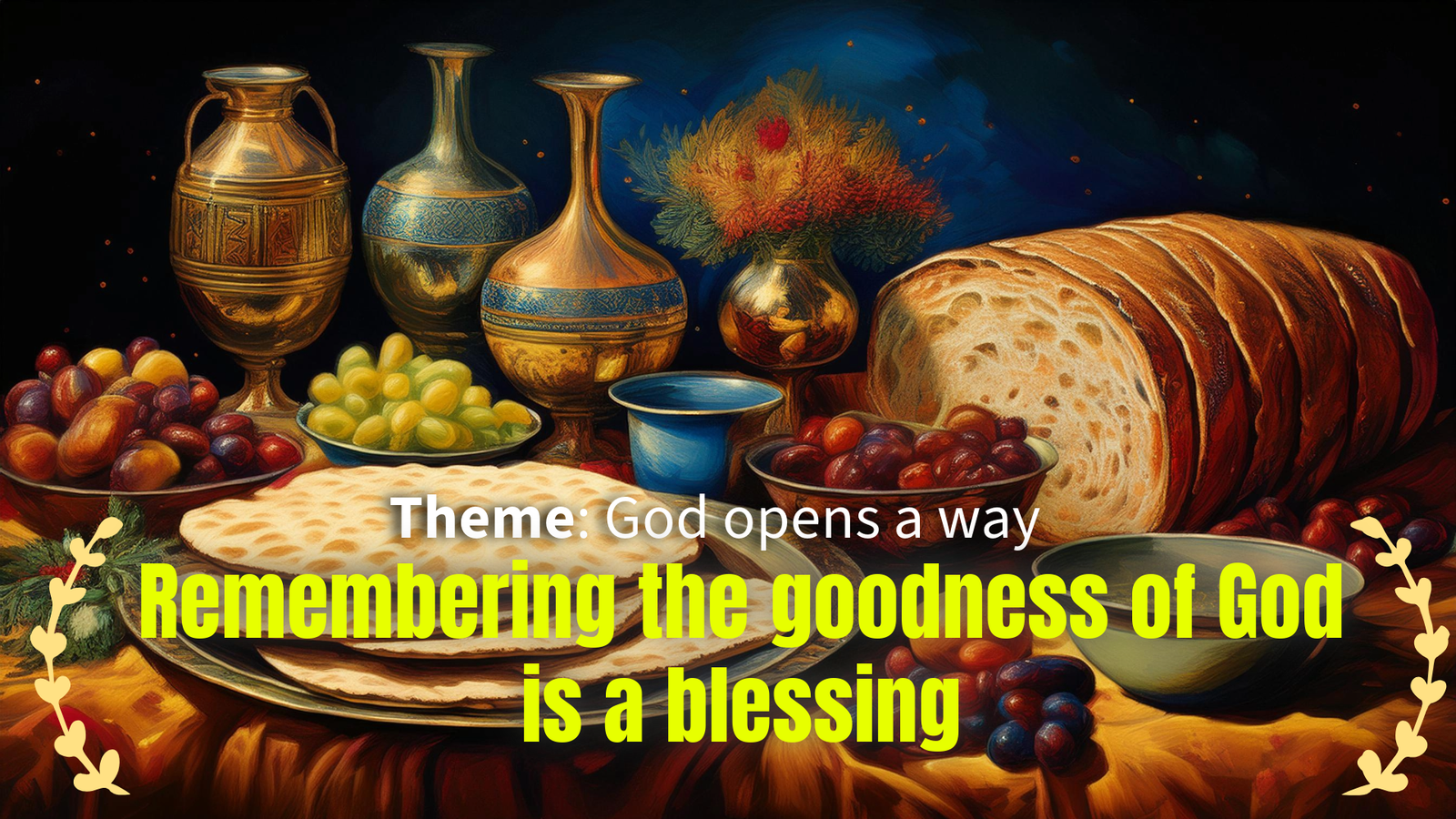
17-Sep-2024 – Remembering the goodness of God is a blessing
Exodus 13:10
“Thou shalt therefore keep this ordinance in its season from year to year.”
In this verse, we see that God is instructing the Israelites to observe specific rituals every year. However, in many of our churches today, we often hear sermons contrasting rituality with spirituality. But if God has commanded something, there must be a purpose behind it, right? Let’s explore this in today’s meditation.
Exodus 13:2
“Sanctify unto me all the firstborn, whatsoever openeth the womb among the children of Israel, both of man and of beast: it is mine.”Exodus 13:15
“But all the firstborn of my children I redeem.”
In this ritual, every firstborn is consecrated to God and belongs to Him, not to their parents. In order to “own” their firstborn, the parents had to pay a price to the Lord. At first glance, this may seem harsh. But what is the purpose behind it?
Exodus 13:15
“And it came to pass, when Pharaoh would hardly let us go, that the LORD slew all the firstborn in the land of Egypt, both the firstborn of man and the firstborn of beast.”
To deliver the Israelites from Egypt, the Lord struck down every firstborn in the land of Egypt. Because this punishment was upon Egypt, everyone, including the Israelites, would have been subject to it. However, God provided a mark for the Israelites on their doorposts—the mark of the blood of the lamb. Every house marked with the blood of the lamb was spared.
If an Israelite had not been in a house marked with blood, they too would have lost their firstborn. So, to remember how God struck the enemy but protected His people, God required the Israelites to observe this ritual. Not only were they to observe it, but they were also commanded to teach their children the reason behind it.
Exodus 13:7-8
“Unleavened bread shall be eaten seven days; and there shall be no leavened bread seen with thee, neither shall there be leaven seen with thee in all thy quarters. And thou shalt show thy son in that day, saying, ‘This is done because of that which the LORD did unto me when I came forth out of Egypt.'”
Another ritual involved eating unleavened bread to remember what the Lord had done in Egypt. But why unleavened bread? Globally, leavened bread is more commonly consumed. It takes time to prepare since it must ferment, and it has a better taste compared to unleavened bread.
However, when the Lord delivered the Israelites from Egypt, there was no time for delay. They had to prepare bread quickly to eat on the move. In a symbolic sense, they had to forgo their desire for savory bread and focus solely on their immediate need. This ritual serves as a reminder that when deliverance is at hand, God moves swiftly and without delay. When that time comes, the focus is not on taste or comfort, but on swift action to align with God’s plan. For this reason, God gave them these rituals.
Today, we too observe the ritual of the Lord’s Table. We do this to remember how the Lord’s body was broken for our deliverance from the bondage of sin, and how His blood was shed to redeem us from sin—transforming our relationship from sinner to saint, and to a child of God. We observe this to remember.
Thus, God uses certain rituals as a way to help us remember His character and His mighty works in our lives.
Prayer
Dear loving Heavenly Father,
Thank You for Your love and grace. Thank You for teaching me today about the importance of rituals. Anything that helps me remember Your wonderful works in my life should be remembered. Help me to realize this and use every opportunity to reflect on Your goodness in my life. I pray in the name of my Lord and Savior, Jesus Christ. Amen!


0 Comments